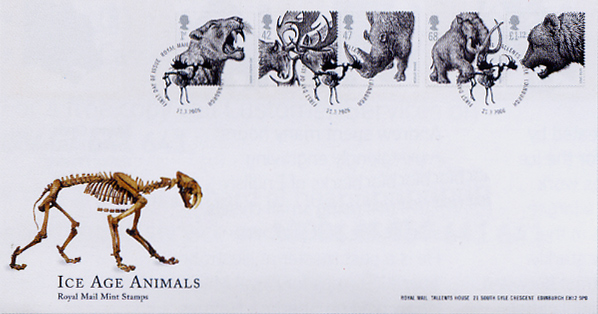
Available with any postmark shown, if ordered by 18 March.
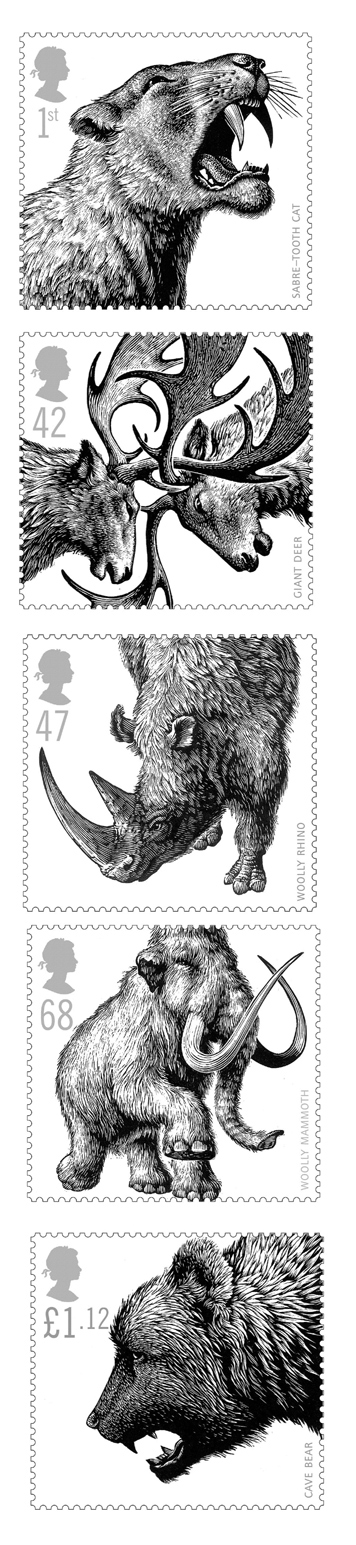
Royal Mail continues the animals theme with a set of 5 striking images of creatures from the ice age which began around 2 million years ago. The set features the giant deer, sabre tooth cat, woolly rhino, cave bear, and woolly mammoth, all of which once roamed the United Kingdom.
1st class - sabre tooth cat (Homotherium latidens)
There were many different species of sabre-tooth cat around the world; all
are now extinct. The last European species, Homotherium, died out about
400,000 years ago. Although overall about the size of a lion, it had a
long neck and relatively long front legs, which together with muscular
forequarters made the animal look more like a hyena than a cat. It pursued
prey such as horses and young mammoths, and used the long canine teeth -
strongly flattened and quite fragile - to press into captured prey rather
than to capture or stab at them.
42p - giant deer (Megaloceros giganteus)
Giant deer had the largest antlers of any known deer, living or extinct.
They grew in size and complexity through the animal's youth, typically
reaching a span of 2.5-3.5 metres in large stags. Shed each year in the
spring, they were grown through the summer, and used in fighting during
late autumn and winter. These huge deer reached around 1.8 m height at the
shoulder and weighed around 500 kg. The giant deer lived in small herds
and was not an abundant species, perhaps because growing the huge antlers
restricted it to areas of mineral-rich vegetation. The last ones died out
only 7,000 years ago in western Siberia.
47p - woolly rhino (Coelodonta antiquitatis)
DNA extracted from frozen carcasses has shown that the woolly rhino was
most closely related to the living Sumatran rhinoceros. It had a body
weight of about 2 tons, a massive shoulder with a height of about 1.8
metres, and a thick mane. The extraordinary front horn was typically 1.2m
long, and very flattened. Close examination reveals that the front edge
had a 'keel', suggesting active side-to-side movements of the head,
perhaps for snow-clearing. Like living rhinos, the woolly rhino was
probably solitary or lived in small groups.
69p - woolly mammoth (Mammuthus primigenius)
Contrary to popular belief, the woolly mammoth was no larger than living
elephants, but with a domed head, sloping back, thick, hairy coat and
enormous spirally curved tusks. It also had tiny ears and a very short
tail - probably to minimise heat loss or frostbite. Stomach remains
preserved in some Siberian carcasses show that the diet was 90% grass,
plus mosses, ferns, and some shrub browse. Living in an open habitat, it
is likely that herds often accumulated into hundreds or even thousands of
animals, but within this smaller family structures, as in living
elephants, still remained.
£1.12 - cave bear (Ursus spelaus)
Fossils of this extinct species have been found only in the middle and
southern latitudes of the European continent. A bear of very large size -
larger than the American grizzly - it was also marked out by a very
pronounced 'step' shape of the forehead. Some caves in central and eastern
Europe have yielded vast quantities of remains - up to 30,000 individuals
in one Austrian cave alone. While most species of the bear family are
omnivorous, recent biochemical analyses of fossil bones confirm that the
cave bear was an exclusive vegetarian.
Technical details:
The stamps, designed by Howard Brown with illustrations by Andrew
Davidson, will be printed in lithography by Joh Enschede Security Print,
size 37x35mm, perforated 14x14.5
All images except FDCs are copyright Royal Mail 2005/6.
Available with any postmark shown, if ordered by 18 March.
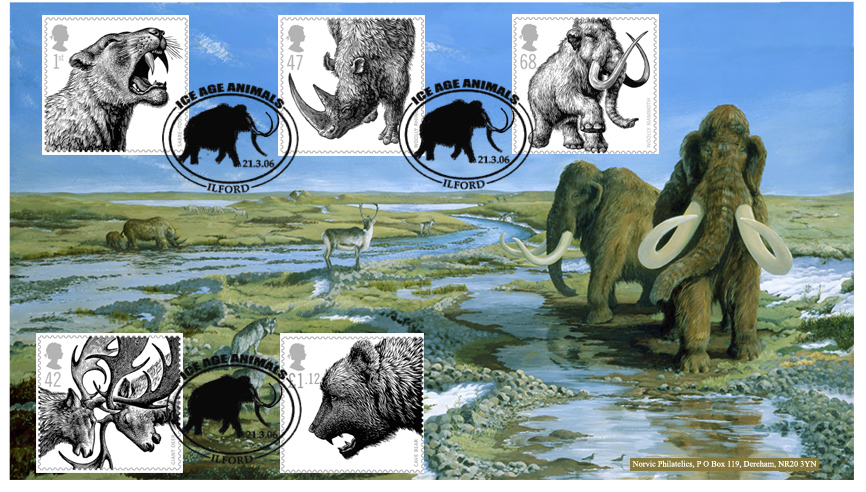
We have again produced exclusive covers for this issue. Limited
edition of 20 illustrated with a picture by Nick Arber, by kind
permission of The Natural History Department, Norfolk Museums and
Archaeology Service, Norwich.
Limited edition of 20 - Price £8.95 ALL SOLD
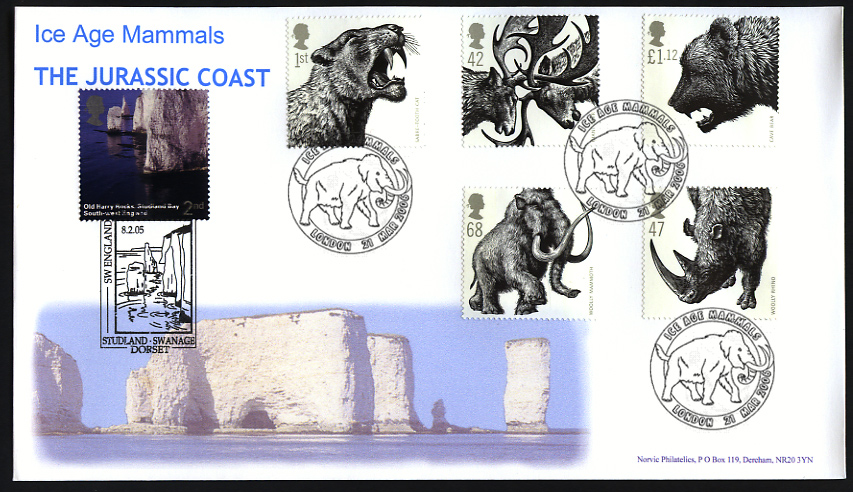
Also Jurassic Coast double-dated fdc illustrated with the
Jurassic Coast of Dorset and East Devon, bearing the 2nd class Studland
stamp postmarked Studland, Dorset on its first day of issue, 8 February
2005, with full set of Ice Age Animals stamps postmarked Ilford as
above, NOT London as shown below. Limited edition of 10 - Price £9.95 ALL
SOLD
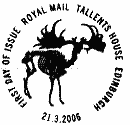
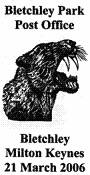
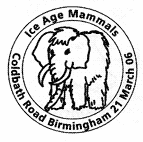
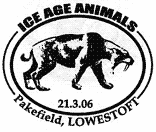
Special postmarks announced for the Day of Issue are shown here.
|

|

|
|
|
| Ref FD609 Philatelic Bureau Official Postmark (Giant deer skeleton) |
Ref FD610 Official Freezywater, Enfield Postmark (Mammoth skeleton) |
Ref FD610NP Official non-pictorial Freezywater postmark |
Ref L9995 Bletchley Park Post Office, Milton Keynes |
Ref M1002 Ice Age Mammals, Coldbath Road, Birmingham |
|
|
|
|
|
| Ref L9991 Ice Age Mammals, Pakefield, Lowestoft [Suffolk] |
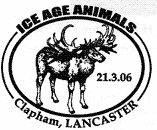
Ref N1006 Ice Age Mammals, Clapaham, Lancaster |
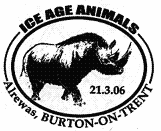
Ref M1001 Ice Age Mammals, Alrewas, Burton-on-Trent [Staffordhire] |
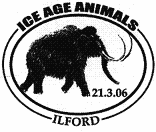
Ref L9990 Ice Age Mammals, Ilford [Essex] |
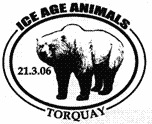
Ref W1008 Ice Age Mammals, Torquay [Devon] |

|

|
|
|
|
| Ref L9999 Save the Rhino, London SE1 |
Ref L9998 Cromwell Road, London SW7 |
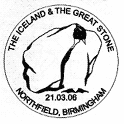
Ref M1003 The Iceland & The Great Stone, Northfield, Birmingham |
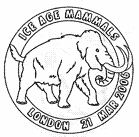
Ref L9996 Ice Age Mammals, London |
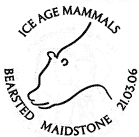
Ref L9997 Ice Age Mammals, Bearsted, Maidstone |
|
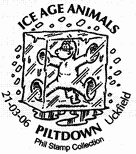
<<<< Ref L9994 Ice Age Animals, Piltdown, Uckfield |
This page updated 10 April 2006.
If you have any questions regarding the stamps on this page,
e-mail us.
|
|
|
|
|||
| January 10 Animal Tales Joint issue with USA Paddington Bear Smilers |
February 7 British Journey - England 23 Bicentenary of Isambard Kingdom Brunel |
March 1 Welsh Assembly MS 7 Fun Fruit 'n' Veg Smilers 21 Ice Age Animals 28 New definitives and country stamps |
April 18 80th Birthday of HM The Queen |
May 25 Smilers Sheet for Washington 2006 Stamp Expo |
June 6 World Cup (Soccer) & Smilers Sheet 20 Modern Architecture |
| July 4 Generic Smilers Sheet - pictorial definitives 18 150th ann National Portrait Gallery |
August 1 & 15 New PIP definitives for new postage rate structure 31 Miniature sheet: Year of the Three Kings 1936 |
September 12 New PIP definitives 21 Victoria Cross |
October 3 Sounds of Britain (Europa) 17 Smilers Booklet and Generic sheet |
November 7 Christmas 9 Lest We Forget 14 Belgica 2006 Smilers Sheet 30 St Andrew's Day |
|
|
|
|||||