Norvic Philatelics - GB New Stamps and Special Postmarks
Working Dogs (Europa 2008) - 5 February 2008
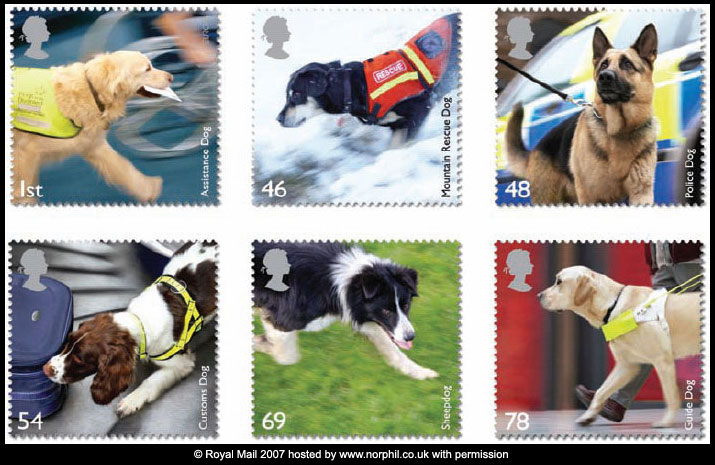
2008 is the centenary of the first Police dogs being deployed in
the UK. The Europa theme is "the letter" and the 1st class stamp
features an Assistance Dog carrying a letter, one of the many tasks
these dogs are trained for. Also featured through specially
commissioned photography by Tim Flach is a Mountain Rescue dog, Police
dog, a Customs or sniffer dog, a Sheep dog and a Guide dog.
|
|
|
Set of 6 stamps:
1st class - Assistance Dog;
46p - Mountain Rescue dog;
48p - Police Dog.
54p - Customs (sniffer) dog;
69p - Sheepdog;
78p Guide Dog.
|
Brief descriptions - dog by dog
1st Class - Assistance Dog
Throughout the UK, there are many charities shrewdly using dogs to help
disabled people
to lead fuller, more independent lives. These include people suffering
from epilepsy, deafness or
mobility problems, who rely on specially trained dogs to raise the
alarm or help with a range of
everyday tasks, from opening and closing doors, switching on lights,
retrieving slippers or keys,
helping someone dress and undress - even taking the laundry out of the
washing machine. The dog shown on the stamp is a Labrador called Rowan.
- Skills: composure, initiative, quick-wittedness, dependability.
- Typical breeds: Golden Retrievers, Labradors and German Shepherds.
46p - Mountain Rescue Dog
The Search and Rescue Dogs
Association was set up by Scots mountaineer Hamish McInnes in the
1960s. It trains dogs to 'air scent' - picking up a human scent blown
towards
them by the wind or air currents, a technique which has proved highly
effective in pin-pointing
lost or injured unfortunates. The dog shown on the stamp is a
Cross-Bred called Merrick.
- Skills: hardiness, warm coat, good with heights, keen sense of smell
and hearing.
- Typical breeds: German Shepherds, Border Collies, Golden and Labrador
Retrievers.
- Tasks: picking up scents, leading a search party, mountain climbing.
48p - Police Dog
The first British police dogs didn't cut the mustard. A pair of
Bloodhounds conscripted to track
down the notorious Jack the Ripper in 1888 they bolted, after one of
them bit the Metropolitan
Commissioner. But today several hundred highly trained animals provide
valuable canine back-up to police forces up and down the country,
helping to apprehend criminals, uncover evidence,
keep unruly crowds under control, as well as sniffing out explosives
and drugs. The dog shown on the stamp is a German Shepherd called Max.
- Skills: Strength, speed, agility, bravery, sense of smell, coolness
under pressure, unswerving loyalty.
- Typical breeds: The German Shepherd, Labrador and Springer Spaniel
have replaced the
original Airedale Terrier.
- Tasks: Guarding, tracking, chasing, sniffing, arresting, community
liaison work.
54p - Customs Dog
It takes around three months of intensive 'hide and seek'-based
training until a customs dog
has the nose and expertise to uncover anything from hidden contraband
and banknotes to illegal
immigrants. Reporting for duty at our ports and airports, these
determined animals are a boon
to national security, ably inspecting passengers, cars, freight
vehicles, aircraft, shipping and any
other nooks and crannies that arouse the suspicions of their handlers.
The dog shown on the stamp is a Springer Spaniel called Max.
- Skills: drive, determination, hunting instincts, a hyper-sensitive
nose.
- Typical breeds: Labrador, Springer Spaniel, Border Collie and some
cross-breeds.
- Tasks: seeking and finding, rooting in tight spaces, thwarting
smugglers.
69p - Sheepdog
The sheepdog has become synonymous with the familiar black-and-white
Border Collie,
popularised by the long-gone TV programme One Man and his Dog.
With a fierce intelligence
and steely glint in their eye perfect for intimidating their ovine
charges, working border collies
can be directed by voice and whistle at long distances. And they're
capable of herding more than
sheep... they'll happily take on cattle, poultry, deer and even the odd
ostrich.
- Skills: obedience, good with sheep and livestock, outdoorsy, won't
take 'no' for an answer.
- Typical breeds: Border Collie, though the Kelpie is favoured in
Australia.
The dog shown on the stamp is a Border Collie called Bob.
78p - Guide Dogs
Dogs have led the blind since Roman times, though the modern guide dog
programme was
introduced in Germany for veterans who lost their sight during WWI. The
system relies on
close partnership between dog and owner, in which both parties are
carefully matched and
rigorously trained. There are some 4,700 guide dogs in the UK, provided
by Guide Dogs for the Blind
for a nominal 50p. The dog shown on the stamp is a Yellow Labrador
called Warwick.
- Skills: obedience, patience, awareness, docility, friendliness.
- Typical breeds: Golden Retrievers, Labradors and German Shepherds.
- Tasks: way-finding, road crossing, avoiding obstacles.
Technical details:
Designed by Redpath using photography by Tim Flach, the stamps are
printed in litho by Cartor Security Printing. The stamps are 35mm x
37mm . All images are by kind
permission of Royal Mail, Copyright 2007/8. This website is copyright
Norvic Philatelics 2008.
Products available:
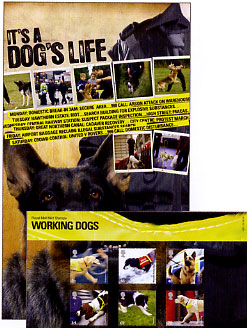
Mint or vfu
Presentation Pack (see right)
Set of 6 Stamp Cards unused
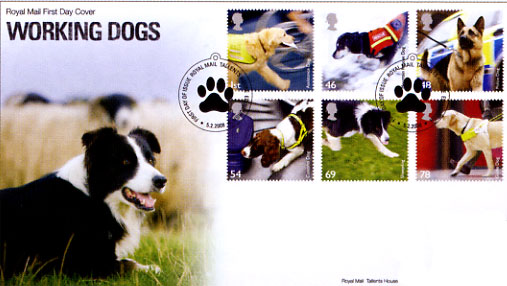
First day cover (see below)
Special Postmarks
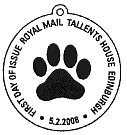
Postmarks available for the day of issue are shown here, these
may not be to scale. These postmarks cannot be obtained after the
date of issue.
 |
 |
 |
|
|
Ref FD803
Philatelic Bureau Official Postmark illustrated with Dog's
pawprint |
Ref FD804
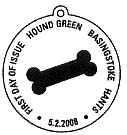
Hound Green, Basingstoke, official postmark illustrated with bone
|
Ref FD804NP
Hound Green Official non-pictorial Postmark |
Ref L10835
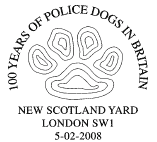
100 Years of Police Dogs in Britain, New Scotland Yard, London SW1 |
Ref L10836
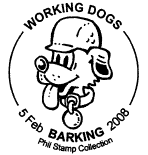
Working Dogs, Barking (Essex) |
|
|
|
|
|
Ref L10837
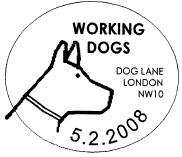
Working Dogs, Dog Lane, London NW10 |
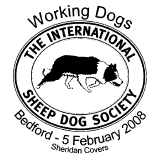
Ref L10838
International
Sheep Dog Society, Bedford |
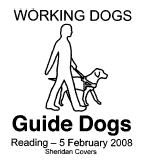
Ref L10839
Guide Dogs,
Reading |
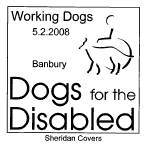
Ref L10840
Dogs
for the Disabled, Banbury |
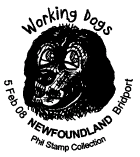
Ref L10841
Working Dogs, Newfoundland, Bridport |

|
|
|
|
|
Ref L10842
Saluting Working Dogs - thrive - London N2 |
Ref M10847
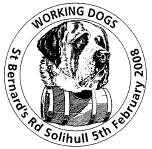
St Bernard's Rd, Solihull |
Ref N10848
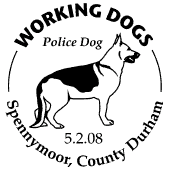
Police Dog, Spennymoor, County Durham |
Ref N10849
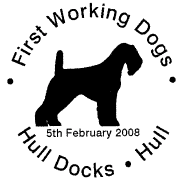
First Working Dogs, Hull Docks [*] |
Ref N10851
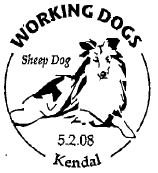
Sheep Dog, Kendal (Cumbria) |
|
<<<<
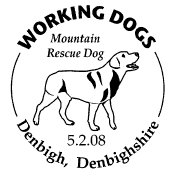
Ref W10853
Mountain Rescue Dog, Denbigh |
Other Location notes
N10849 - Hull Dock Police - read the story here
|
If you wish to be told when this page is updated, please use the
ChangeDetection box at the top of this page.
This page updated 16 March 2008